MPI_File_set_view
Sets the file viewint MPI_File_set_view( MPI_File mpi_fh, MPI_Offset disp, MPI_Datatype etype, MPI_Datatype filetype, char *datarep, MPI_Info info ); int MPI_File_set_view( MPI_File mpi_fh, MPI_Offset disp, MPI_Datatype etype, MPI_Datatype filetype, wchar_t *datarep, MPI_Info info );
Parameters
- mpi_fh
- [in] file handle (handle)
- disp
- [in] displacement (nonnegative integer)
- etype
- [in] elementary datatype (handle)
- filetype
- [in] filetype (handle)
- datarep
- [in] data representation (string)
- info
- [in] info object (handle)
Remarks
The MPI_FILE_SET_VIEW routine changes the process's view of the data in the file. The start of the view is set to disp; the type of data is set to etype; the distribution of data to processes is set to filetype; and the representation of data in the file is set to datarep. In addition, MPI_FILE_SET_VIEW resets the individual file pointers and the shared file pointer to zero. MPI_FILE_SET_VIEW is collective; the values for datarep and the extents of etype in the file data representation must be identical on all processes in the group; values for disp, filetype, and info may vary. The datatypes passed in etype and filetype must be committed.
The etype always specifies the data layout in the file. If etype is a portable datatype, the extent of etype is computed by scaling any displacements in the datatype to match the file data representation. If etype is not a portable datatype, no scaling is done when computing the extent of etype. The user must be careful when using nonportable etypes in heterogeneous environments.
If MPI_MODE_SEQUENTIAL mode was specified when the file was opened, the special displacement MPI_DISPLACEMENT_CURRENT must be passed in disp. This sets the displacement to the current position of the shared file pointer.
Rationale.
For some sequential files, such as those corresponding to magnetic
tapes or streaming network connections, the displacement may
not be meaningful. MPI_DISPLACEMENT_CURRENT allows the view to be
changed for these types of files. ( End of rationale.)
The disp displacement argument specifies the position (absolute offset
in bytes from the beginning of the file) where the view begins.
Advice to users.
disp can be used to skip headers or when the file includes a sequence of data segments that are to be accessed in different patterns (see Figure 15 ). Separate views, each using a different displacement and filetype, can be used to access each segment.
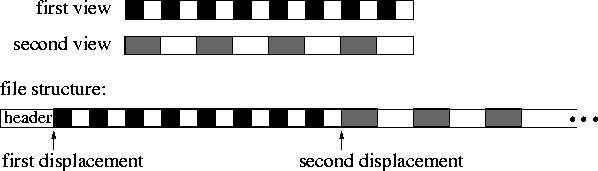
Figure 15:
[ ]Displacements ( End of advice to users.)
An etype ( elementary datatype) is the unit of data
access and positioning. It can be any MPI predefined or derived datatype.
Derived etypes can be constructed by using any of the MPI datatype
constructor routines, provided all resulting typemap displacements are
nonnegative and monotonically nondecreasing. Data access is performed in
etype units, reading or writing whole data items of type etype. Offsets
are expressed as a count of etypes; file pointers point to the beginning
of etypes.
Advice to users.
In order to ensure interoperability in a heterogeneous environment,
additional restrictions must be observed when constructing the etype. (
End of advice to users.)
A filetype is either a single etype or a derived MPI datatype
constructed from multiple instances of the same etype. In addition, the
extent of any hole in the filetype must be a multiple of the etype's
extent. These displacements are not required to be distinct, but they
cannot be negative, and they must be monotonically nondecreasing.
If the file is opened for writing, neither the etype nor the filetype is permitted to contain overlapping regions. This restriction is equivalent to the "datatype used in a receive cannot specify overlapping regions" restriction for communication. Note that filetypes from different processes may still overlap each other.
If filetype has holes in it, then the data in the holes is inaccessible to the calling process. However, the disp, etype and filetype arguments can be changed via future calls to MPI_FILE_SET_VIEW to access a different part of the file.
It is erroneous to use absolute addresses in the construction of the etype and filetype.
The info argument is used to provide information regarding file access patterns and file system specifics to direct optimization. The constant MPI_INFO_NULL refers to the null info and can be used when no info needs to be specified.
The datarep argument is a string that specifies the representation of data in the file. See the file interoperability section for details and a discussion of valid values.
The user is responsible for ensuring that all nonblocking requests and split collective operations on fh have been completed before calling MPI_FILE_SET_VIEW---otherwise, the call to MPI_FILE_SET_VIEW is erroneous.
Example Code
The following sample code illustrates MPI_File_set_view.
#include "mpi.h"
#include <stdio.h>
#include <stdlib.h>
/* Test set_view with DISPLACEMENT_CURRENT */
int main( int
argc, char *argv[] )
{
int errs = 0,
err;
int size, rank, *buf;
MPI_Offset offset;
MPI_File fh;
MPI_Comm comm;
MPI_Status status;
MPI_Init( &argc, &argv );
/* This test reads a header then sets
the view to every "size" int,
using set view and current displacement. The file is first written
using a combination of collective and ordered writes */
comm = MPI_COMM_WORLD;
err = MPI_File_open( comm, "test.ord", MPI_MODE_WRONLY | MPI_MODE_CREATE,
MPI_INFO_NULL, &fh );
if (err)
{
MPI_Abort(MPI_COMM_WORLD, 911);
}
MPI_Comm_size( comm, &size );
MPI_Comm_rank( comm, &rank );
buf = (int *)malloc(
size * sizeof(int)
);
buf[0] = size;
err = MPI_File_write_all( fh, buf, 1, MPI_INT, &status );
if (err) {
errs++; }
err = MPI_File_get_position( fh, &offset );
if (err) {
errs++; }
err = MPI_File_seek_shared( fh, offset, MPI_SEEK_SET );
if (err) {
errs++; }
buf[0] = rank;
err = MPI_File_write_ordered( fh, buf, 1, MPI_INT, &status );
if (err) {
errs++; }
err = MPI_File_close( &fh );
if (err) {
errs++; }
/* Reopen the file as sequential */
err = MPI_File_open( comm, "test.ord", MPI_MODE_RDONLY | MPI_MODE_SEQUENTIAL
| MPI_MODE_DELETE_ON_CLOSE, MPI_INFO_NULL, &fh );
if (err)
{
MPI_Abort(MPI_COMM_WORLD, 911);
}
if (rank == 0) {
err = MPI_File_read_shared( fh, buf, 1, MPI_INT, &status );
if (err) {
errs++; }
if (buf[0] !=
size) {
errs++;
fprintf(stderr, "Unexpected value for the header = %d, should be %d\n",
buf[0], size ); fflush(stderr);
}
}
MPI_Barrier( comm );
/* All processes must provide the same
file view for MODE_SEQUENTIAL */
err = MPI_File_set_view( fh, MPI_DISPLACEMENT_CURRENT, MPI_INT, MPI_INT,
"native", MPI_INFO_NULL );
if (err) {
errs++; }
buf[0] = -1;
err = MPI_File_read_ordered( fh, buf, 1, MPI_INT, &status );
if (err) {
errs++; }
if (buf[0] !=
rank) {
errs++;
fprintf( stderr, "%d: buf[0] = %d\n", rank, buf[0] ); fflush(stderr);
}
free( buf );
err = MPI_File_close( &fh );
if (err) {
errs++; }
MPI_Finalize();
return errs;
}
DOWNLOAD
Win32 DeinoMPI.2.0.1.msi
Win64 DeinoMPI.x64.2.0.1.msi